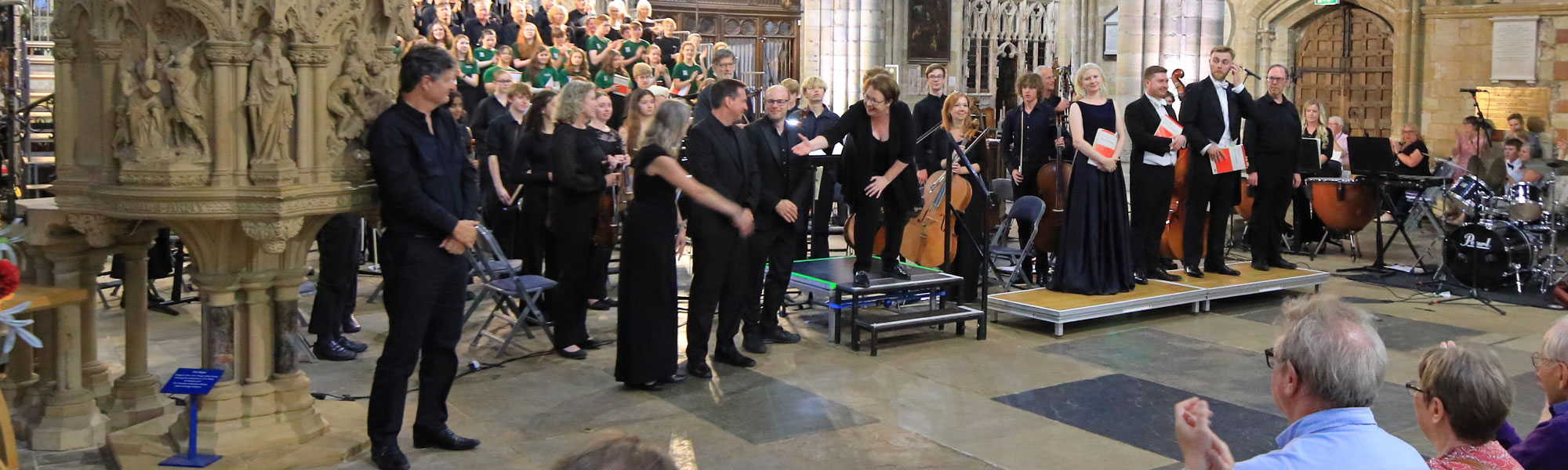
Saturday 5 April 2025
St Peter's Church, Budleigh Salterton
Qui sedes ad dexteram patris. Ever since Exeter Festival Chorus’ concert last Saturday
in Budleigh Salterton, this phrase from Poulenc’s Gloria has been bouncing around my
brain.
It won’t let go. It is perhaps a reflection of the choir’s energy and confidence that
has driven Poulenc’s spiky rhythms into my head’s inner ear.
There was a great deal to appreciate about Saturday’s whole performance. Confidence
and consistency are the two features which were particularly striking. This was a well-
rehearsed performance demonstrating a high standard of ensemble music-making.
The programme was well chosen. It moved from the reflection of Duruflé’s Requiem to
the sparky joy of Poulenc’s Gloria, mirroring the programme’s theme of light and
shadow. In the middle EFC gave the world premiere of Russell Hepplewhite’s I Wake,
one of ten new settings of poetry to be sung by ten different choirs. Under the collective
title of Living Voices the poems focus on different aspects of contemporary life, and
were specially commissioned by the composer from different British poets.
In I Wake poet Wendy Cope expresses relief at surviving an undisclosed surgical
operation. It is arguably a rather strange choice of topic, but its sense of wonder and
redemption made it a good fit with the Duruflé and Poulenc, as did its musical language.
An essentially tonal piece, its harmonies and textures are pleasingly accessible. EFC
sang it by heart and in doing so brought out its expressive qualities to the full. It is good
to see EFC continuing its well-earned reputation for tackling new work and extending
choral repertoire.
Throughout the evening the choir demonstrated a close attention to dynamic shading
and rhythmic subtlety. Noticeable too was the sensitive way in which they adjusted their
vocal colour when accompanying one of the two soloists... In her printed programme
introduction musical director Andrea Brown highlighted the use of vocal chant which
threads through all three pieces. In such passages the choir demonstrated a free-flowing
flexibility. Voice parts were well balanced and tutti passages blendedpleasingly. The addition
of visiting tenors was useful in this respect.
My only quibble would be the very occasional hesitancy leading to slightly under par
intonation when a single voice part entered on their own, in Duruflé’s Agnus Dei, for
example.
This brings me to the evening’s soloists and instrumentalists, all of whom have
connections to the South West. Baritone Timothy Dickinson and soprano Gweneth
Ann Rand have strong operatic voices which added richness and power to both Duruflé
and Poulenc. Rand’s ability to conjure high notes out of Poulenc’s ether certainly had
that wow factor. Cellist Isabella Farleigh played with poignant beauty in Duruflé’s Pie Jesu,
while organist Andrew Millington provided an assured accompaniment. His registration
created some particularly sensitive colours to both Duruflé and Poulenc with some suitably
reedy registrations in Poulenc’s Gloria.
Performing is not only a question of musical standards. Projecting an on-stage
presence, creating a confident, not showy, sense of professionalism are vital parts of
building rapport with the audience. In the past I have sometimes felt EFC could
sharpen their act in this respect. However, on Saturday there was palpable focus,
which produced an energy and vibrancy on which all concerned are to be congratulated.
Andrea Brown can no longer be described as EFC’s “new” musical director. This
concert was evidence of a maturing relationship of trust and mutual creativity.
D dlC
April 2025.