Concert Reviews
Monteverdi Vespers of 1610
Saturday 11 July 2026
Exeter Cathedral
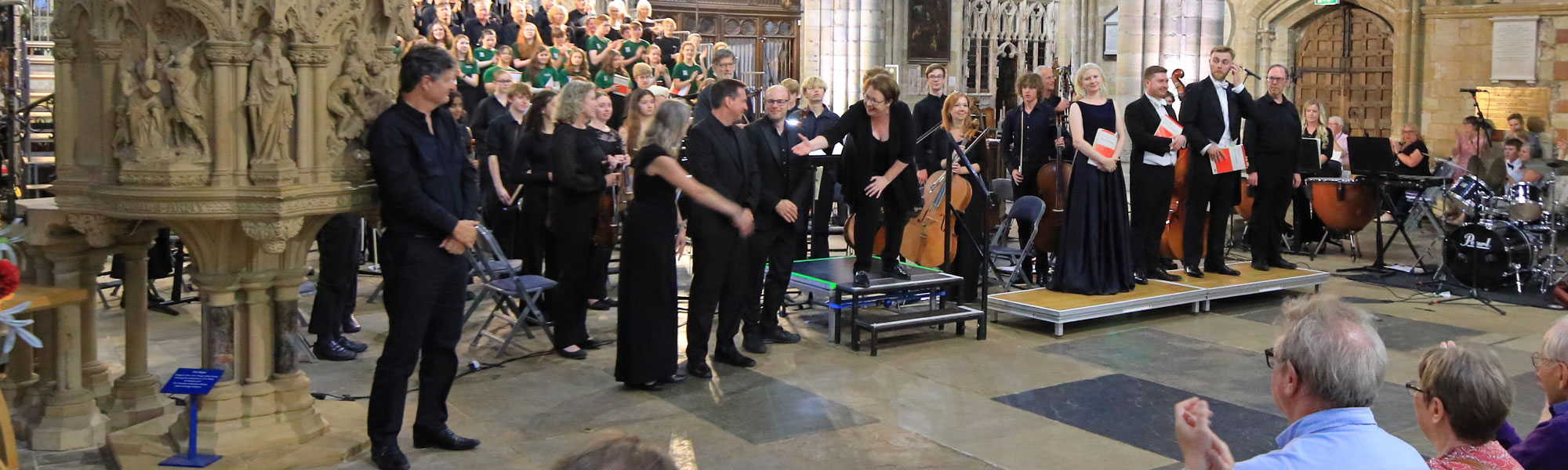
Exeter Cathedral was the place to be on Saturday night! Escaping the searing heat, in perhaps the coolest spot in the city, we were treated to a spectacular performance of Monteverdi’s Vespers of 1610 by Exeter Festival Chorus, in collaboration with Devon Baroque Orchestra, members of the English Cornett and Sackbut Ensemble, and the Contrepoint Vocal Octet.
It is always good to see different groups of musicians coming together. No doubt this collaboration must have entailed quite a feat of organisation, but Exeter Festival Chorus relishes such challenges in its constant endeavour to bring exciting, ambitious and varied programmes. This concert, featuring a work of such scale, variety and theatricality, involving so many musicians and wonderful instruments was an auditory and visual spectacle that may be hard to surpass!
At the heart of this performance was the desire to present the music as Monteverdi may have imagined it, with the instrumental and vocal colours, textures and stylistic techniques of seventeenth century Northern Italy. The period instruments in themselves impart some of the tonal and textural qualities. Additionally, it was decided to perform the work at the pitch A = 465 Hz, approximately a semitone higher than our present-day A = 440 Hz, the higher pitch reflecting the organ pitch of Monteverdi’s locality and era. As musical director, Andrea Brown, explained this “fundamentally alters the work's sonority. The increased tension on period strings and the higher placement for singers creates a shimmering, urgent texture that avoids the more subdued feel of lower-pitched modern interpretations.” To ensure that the voices were kept within range the movements written in high clefs (Lauda Jerusalem and the Magnificat) were, as often, transposed down, reflecting historical performance practice.
Monteverdi’s Vespers is a complex work, with its constantly changing vocal scoring, ranging from 7-part choir and 4-four-part double choir, down to single voice parts, for example in the Magnificat. It is both incredibly busy and dense, and also, at times, very exposed. Add to this, constant and swift changes of metre and mood. Exeter Festival Chorus sang with commitment and joy under the spirited direction of Andrea Brown. There was much incisive singing, vigorous and rhythmic, with clear diction. I particularly enjoyed the buoyancy of the opening section of Laudate pueri, followed later in the movement by some lovely lyrical singing. The choir shone in Lauda Jerusalem with its crisp consonants, some confident high soprano lines, and jaunty flourishes, whilst the tenors resolutely held their cantus firmus. Monteverdi gave no instructions about dynamics, tempi or articulation, so each conductor brings their own interpretation. Andrea Brown infused the work with vitality and vibrancy, constantly alert to changes of character, deftly steering her performers through frequent juxtapositions of vigour, and a more expressive, legato style.
It was lovely that the solo roles were given to the young singers of the vocal octet, Contrepoint. All established professionals, singing individually with many world-class ensembles, they showed a real affinity for this music, with its demands of virtuosic melismatic writing, rapid repeated notes, and expressive declamation. They sang with clarity, control and expression, bringing out the meaning and emotion of the text. The space in the cathedral was used to dramatic effect, with the echoes coming from different locations, sometimes behind the choir, sometimes behind the audience, and I particularly liked the way in which the soloists communicated in their ensemble movements. In the duet Pulchra es, for example, the two soprano soloists frequently turned to each other, exchanging their vocal lines as if in conversation, giving a real chamber-music feel. In a work which often feels quite grandiose these solo movements provide moments of intimacy, perhaps nowhere more so than in the tenor motet Nigra sum. This was particularly captivating in the beautiful synchronicity between the soloist and theorbo player, with sensitively timed cadences. Some of the vocal phrases began almost imperceptibly, building to a sonorous resonance, with persuasive expression of Monteverdi’s word-painting, as on ‘surge’ (arise).
The combined forces of Devon Baroque Orchestra and members of the English Cornett and Sackbut Ensemble brought energy and colour to this performance. Many of the period instruments were beautiful to look at, and the physicality of playing them compelling to watch. The playing was full of vitality, and the violins, with their strings at high tension, had a more earthy, rustic sound than the modern violin, blending more closely with the cornetti. Meanwhile the lower strings and brass had a lovely rich, bell-like sonority. The instruments provided dramatic fanfares, impressive virtuosity (particularly from violins and cornetti), and sensitive continuo accompaniment, bringing something of the drama of opera to the world of sacred music. It was interesting to see the second violin turn to face away from the first (and the audience) enhancing the echo effect during their virtuosic exchange in the Deposuit potentes section of the Magnificat. And I particularly enjoyed some of the ad libitum flourishes at the end of movements, such as that of the violone at the close of Laetatus sum. Numerous smiles indicated that the instrumentalists were enjoying themselves, and I even saw a few joining in with the singing on occasion!
Thank you to Andrea Brown and all the performers for presenting such an engaging and entertaining concert, fusing artistic integrity, ambition, and the joy of making music together.
Annabel Rooney
December 2025: 12 Days
Celebrating December's Musical Calendar
Saturday 13 December 2025
St Peter's Church, Budleigh Salterton
What a creatively designed programme, celebrating twelve occasions in December’s musical calendar – ‘12 Days’.
July 2025: A New Creation
Saturday 12 July 2025
Exeter Cathedral
What a creative, imaginative, logistically challenging and experiential programme!
April 2025: Of Light and Shadow
Saturday 5 April 2025
St Peter's Church, Budleigh Salterton
Qui sedes ad dexteram patris. Ever since Exeter Festival Chorus’ concert last Saturday
in Budleigh Salterton, this phrase from Poulenc’s Gloria has been bouncing around my
brain.
December 2024: Christmas Classics
Saturday 14 December 2024
Exeter Cathedral
A packed cathedral enjoyed a wonderful evening of seasonal music and readings performed by Exeter Festival Chorus
November 2024: Rossini Petite Messe Solennelle
Saturday 16 November 2024
St David's Church, Exeter
Rossini was such a tease! His Petite Messe Solennelle was neither little (about the same length as Verdi's Requiem), nor especially solemn.
July 2024: Bach Mass in B minor
Saturday 6 July 2024
Exeter Cathedral
A memorable and uplifting performance
Yesterday evening Exeter Cathedral welcomed a large audience to hear Exeter Festival Chorus perform Bach’s magnificent Mass in B minor, directed by Andrea Brown, with the Devon Baroque orchestra and five soloists. This is a monumental work, with about two hours of choral singing, arias, duets and orchestral marvels.
March 2024: Of Music and Invention
Saturday 23 March 2024
St. Peter’s Church, Tiverton
Where, one might ask, could you go to learn a lot about Leonardo da Vinci and choral music old and new in one hit? The answer is St, Peter’s Church, Tiverton last Saturday evening. In a cleverly-constructed programme entitled Of Music and Invention, Exeter Festival Chorus presented an appreciative audience with the answer.
February 2024: Carlos Acosta 'On Before'

Tuesday 27 & Wednesday 28 February 2024
Theatre Royal, Plymouth
In celebration of his 50th birthday, the iconic Carlos Acosta has come out of retirement to tour the On Before medley originally devised in memory of his mother.
December 2023: Northern Lights
Saturday 16 December 2023
St. David's Church, Exeter
Exeter Festival Chorus’ Christmas concert was a skilfully designed programme of music to represent the mysterious and ethereal qualities of the Northern Lights.
More Articles …
Page 1 of 4